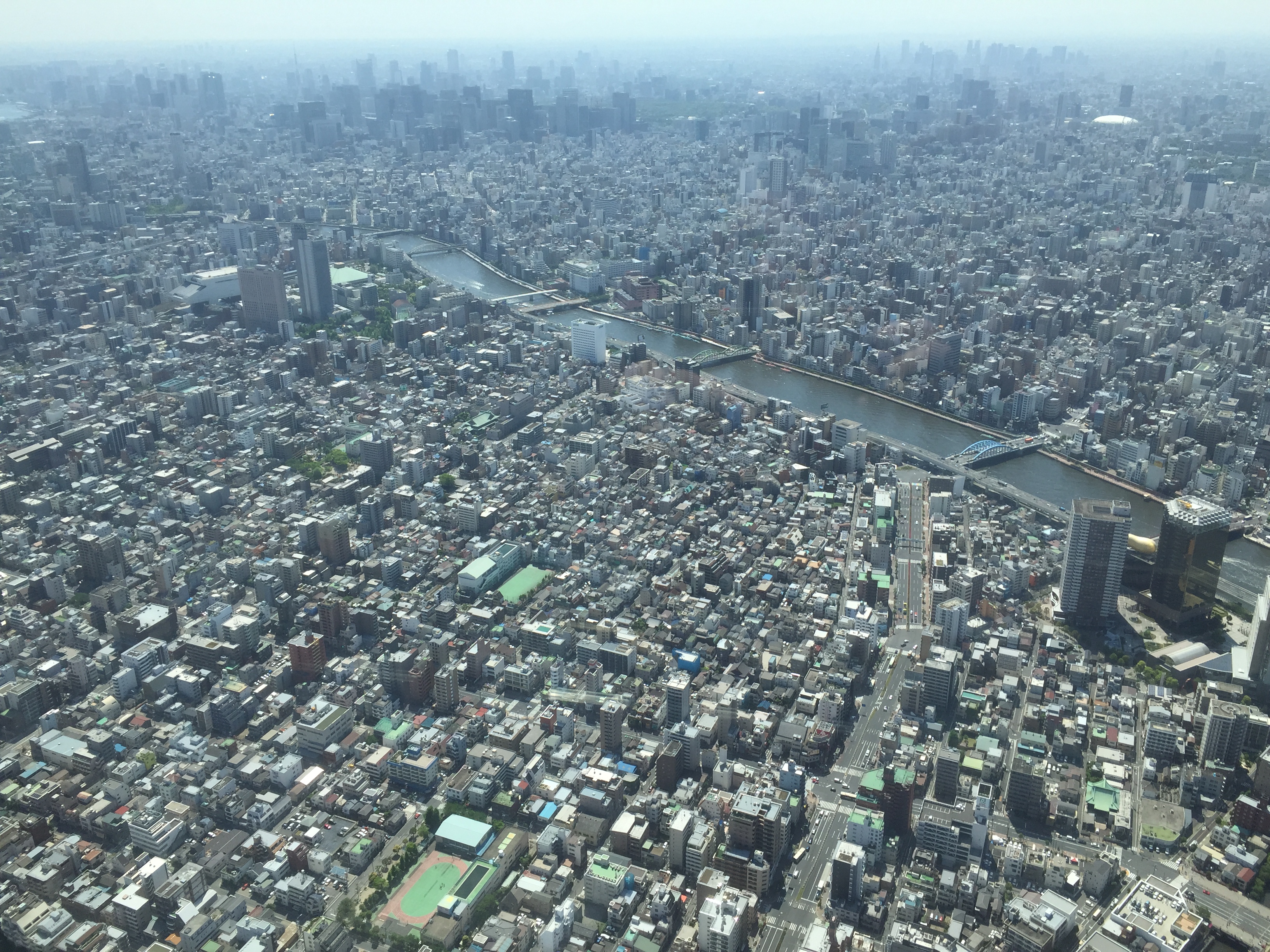
Yesterday, at the 22. More 2012, was the 634 Meter high Tokyo Sky Tree was officially inaugurated – Unfortunately, under very unfavorable conditions, because it was raining all day. This means, the lucky ones, The months in advance tickets for the viewing platforms on 350 and m 451 m did not catch, pretty much did nothing. After the opening of the Tokyo Gate Bridgethus, a second new landmark of Tokyo inaugurated within three months of well-. The baptism of fire emblem already had both the most severe earthquake 11. March 2011 were. Although both buildings were not finished yet, but if known, the constructions put away the earthquake problem.
Tokyo Sky Tree – this is not just the tower itself, but also a great, connected building complex called 東京スカイツリータウン Tokyo Sky Tree Town with a total of 230 000 m² of building space. There are housed a shopping center, a planetarium, and the Sumida-Aquarium すみだ 水族館. The latter is in a giant aquarium, underwater world of the Ogasawara(also: Bonin called)Islands to and should probably be quite impressive - a taste of the news section below provides. In addition to the complex is also still the same to another, new shopping center, called 東京ソラマチ Tokyo Solamachi.
From Tokyo Sky Tree promises to be an invigorating effect on the economy of the surrounding area, and that might arrive too, because numerous Japanese love the tower already. Of course, the tower also brought a few problems with it, but it can be heard – this is typical for Japan – little:
The tower construction site September 2009
- the environment is an old, traditional neighborhood (a typical Old town – shitamachi – Undercity, and the tower is roughly the area from the sleeping tear. That's right. Sure, the land prices to skyrocket (or. this will be done already) and displace many long term residents.
- Snow clumps, falling from the tower (600 m as provide for a proper speed) are a problem for the environment, especially strong winds often prevail here
- The tower is currently disturbs the still of the old Tokyo Tower outgoing radio waves, what are some areas in the north of Tokyo is already noticeable
Here are some trivia on Tokyo Sky Tree. Note especially the speed: From initial concept to full completion were not needed 10 Years, what a project this size is more than remarkable.
The idea for the tower was built 2003
The site was 10 Months later, and chosen more 5 Months later decided
In March 2008 was clear plan of, In June, the MSRP (Environmental Impact Assessment) completed
Construction began in December 2008
The tower is lower triangular and round above
The upper viewing platform on 451.2 m is the second highest in the world (more) – according to the World Financial Center in Shanghai
Japanese people can remember easily, the amount, because 634 man kann Mu-sa-shi (Musashi) read (The old name of the area around Tokyo)
The entrance to the lower platform 350 m costs 2,500 Yen (about 20 Euro)
The entrance to the upper platform 450 m It is available again 1,000 Yen (8 Euro)
For now, it comes up with pre-. By the end of July, the tower is already fully booked
An enterprising Chinese has the name “Tokyo Sky Tree” copyright protection in China can, what was the problem for the shareholders: They subsequently had the Chinese name “東京天空樹”Tokyo Sky Treeimmelsturm) in “Tokyo tower clear skyabout (etwa: Tokyo descend clearance Heaven-Turm) modify - the same goes for the station name
As already here announced, it was this morning at 7:30 a solar eclipse in Tokyo. No total, but a ring-shaped. If hot, It was not really dark, but the light was strangely diffuse. The weather was at least a little with. It was, at least with us, Although cloudy, But sometimes the sun came, or. the, what it was still visible, easily by.
Annular solar eclipse on 21. More 2012 in Tokyo
You have to say almost “well, that it was not cheerful” - A week ago I had seen only once eclipse glasses, never again: Everywhere they were sold out. If it had been completely overcast, I'd have to really annoy me, no glasses or bought earlier. order online to have…
Actually, I wanted to write even more, But better late than too late: At the 21. May it be in Tokyo, a complete (more specifically: ring-shaped) Eclipse give. The umbra moves past it and not close to Tokyo, but really just about it - see map below.
As the shadow comes from the southeast, He crosses almost all of Japan - the core hours are as follows:
All times in the morning, understood. The annular eclipse will take it around your 5 Minutes, if you are in the center is. Incidentally, this eclipse crossed before, Hong Kong and Canton and is thus very, many people are seen. The good thing: Even if it should be clear, a total solar eclipse is noticeable. Also, at the 21. May not forget to get up early!
Visit from their old home is always a good opportunity, To see things in Japan, it has not yet seen. Clear, you should first show places, you yourself already well known. Is the visit, however, for the fourth time to visit, You can open up something new like. For example, the pub in the house. For almost two years I have lived in my current apartment. Together with 10 other tenants (what a strange word) and a pub on the ground floor. In which I had hitherto been unable effectively. But only at the margins.
For two days it went to Tokyo. And I do not mean THE Tokyo, but the other. Is hardly known outside of Japan, that 2 to Tokyo, and subtropical islands and’000 Meter-high mountains are. In other words, many associate with either the Tokyo city center itself OR the entire metropolitan area, Tokyo, including portions of the neighboring Saitama Prefecture, Chiba, Kanagawa, Gunma, Tochigi und Yamanashi. The former is called colloquially the Area 23 (My nijūsan, the 23 -ku-mentioned districts) and officially The Tokyo Metropolitan Area (Tokyo Kubu), the latter 首都圏 Shutoken (Capital Region).
Funicular to Mitake-san
Administratively, there is no way Tokyo. Tokyo – this is actually 東京都 Tōkyō-to. The to-one reads miyako and that means “Capital”. Tokyo is one of the 47Province (TOdōfuken) – 47 Prefectures, and only allowed the Tokyo-to bear on behalf, although Osaka is currently trying, its suffix-TO-FU into a convert. The confusion around Tokyo and Tokyo-to, you can well see in Wikipedia: The page goes on about Tokyo Japanese actually only the name and the fact, when and how Tokyo is classified administratively. There are few links to articles about Tokyo in other languages – including the German main page about Tokyo (Status: Excellent article), But there is no link to the English articles. However you look at the wiki article on Tokyo to Japanese, there are countless languages – including the link to the prefecture of Tokyo in German and English on the link above Tokyo. Clean up on its own initiative because somebody would have to. When I have a lot of time ...
View from the funicular railway station to the village and to the shrine. Here, the cherry blossoms even in early May
Most visitors only see from the above Tokyo 23 -ku and Takao in the Southwest – that belongs to the city 八 王子 Hachioji. But there is still much more to see, and little by little I will even travel to describe this other Tokyo and. So for example 御 岳山 Mitake-san in the northwest of Tokyo to the city 青梅市 Ōme-shi (Literally: “Green Plum”). The journey has been interesting: From the skyscrapers in Shinjuku sea you go with a normal express train in the Chuo line for an hour to Ome. From there it just goes with the Ome Line 20 More minutes to the train station 御 岳 Mitake. The mountains are already beginning to Ome, Mitake and is already in the middle of the mountains on a steep river valley. From there, good 10 Minutes by bus to the funicular station. The former is almost 1 Kilometers long and, through 400 Meters back. And here – and so fast to get from Tokyo to the mountainous juggernaut, deposited over Tokyo 800 Meters. Here it is equal to times the average 7 Degrees colder than “below”.
What is to be up there? Upstairs there is a small village with very, very narrow streets, many hostels (Fortunately, these are all very small, mostly traditional Japanese inns and No huge). The streets and the only access road to the site are so closely, that only Kei-Cars (Easy cars) go up with the special approval must. Flashing lights on the roof seem to be required to be. This is of course very rare in Japan: A place, through which one can walk relatively relaxed, without lights and without the constant worry, lack of sidewalks and traffic safety awareness down to the nearest street corner to the winds to be.
Ehrlich, das ist in Tokyo! And not a museum, only one house!
Mitake is significant because of its shrines. “Mitake” literally means “revered mountain” and the name suggests, that this is a (mostly Shinto) important religious site is. In this case, this is the Musashi Mitake Shrine (Musashi-Mitake Shrine)on the top of 929 Meters high Mitake. The cornerstone was the legend, already 91 set BC, However, this information must be treated with caution. The entrance to the shrine is quite bombastic, mit massif Granittreppen, But the shrine itself is surprisingly small – and finely. Majestic Japanese cypress (hinoki – a Scheinzypressenart) surround the shrine, and are also quite common.
The Musashi-Mitake Shrine. Completely with no people!
From Mitake-san himself from numerous hiking trails go - they lead through dense forests on steep slopes along, with waterfalls here and there. There is also something for everyone here - walks for long walks in the woods up to, challenging routes, the lead in part to a few thousand in the area. In good weather there is the area of even a really good view of Tokyo. This is of course nice day - but much more impressive at night. However, one must move in the winter to Miyake-san, Otherwise, the chances are relatively poor for a clear view.
Mitake-san at the waterfall
Conclusion: Takao is like a Pflichtabstecher from Tokyo, but who has left for another day or to live in Japan, which was a side trip to Miyake-san highly recommended. Incidentally, we stayed in a Japanese inn, called 能 保 利 Nobori. No sooner had we parked our luggage in the room, were the two small children (5 Years and 6? 7? Years). By reserving the children did seem to, I had a 5-year-old daughter with. The was only too happy to – and now raged with the two children of the operator through the entire house. The food there was also quite excellent. In traditional hostels in shrines and temples are mostly vegetarian food – here there were also fish (Brook trout - a rarity in Japan, da kein Meeresfisch) and mussels. Most of the estimated 15 to 20 Vegetarian delights, however, were, and invariably delicious.
The table is covered well - and that's not even half
So, that was about it. In the near future there will be an extra page in my Tokyo-Sektion give. Who more excursions in the western part of Tokyo prefecture has - just tell me!
Entertainment show with dinner: TV does not need to
With great interest I have pursued the Grass-poem and the subsequent reactions. Very exciting, all, but since it's not about Israel but about Japan, I will express myself not to. Similar waves hit this country since yesterday, but observations by the Governor of Tokyo, Ishihara, yesterday at a press conference (or previously?) once had the same idea, that it would be a good thing but, wenn Tokyo-to (Tokyo, the management unit) the 尖 阁 诸岛 Senkaku Islands would buy. Those are in the triangle between Okinawa, Taiwan and the PRC and are currently or. since the 1930s to the prefecture of Okinawa, more specifically to the community in Ishigaki. The island group consists of 5 Islands and 3 Reefs, is generally good 5 Square kilometers and has 0 Population. Up to the nearest inhabited island is around 130 Kilometer. Interestingly, the current ownership: 4 The islands have been the end of the 19. Century for 30 Leased to the contractor Koga years – because without associated conditions. Only 1895 the Japan Islands verleibte an official, after a review of, that the islands belong to anyone other. Koga tried in subsequent years, the islands to open up economically, But lack of water was not very easy task – Agriculture is not just possible. Nevertheless, lived before the 2. World War to 200 Japanese on the island – in the village of Koga. After the war, disappeared people, and Okinawa was administered by the U.S.. According to Japanese sources, then poach the Taiwanese fishing island, disappeared almost all seabirds. To 1968 otherwise no one really interested in the islands - until oil was discovered in the area. Now, suddenly raised Taiwan and the PRC claims to the islands.
1932 Koga's son bought the islands of the State (with the exception of the Taishō Island) from. Nothing has changed to this day: The smallest of the islands (Taishō-Insel) belongs to the Ministry of Finance; the other four islands are privately owned. Since the owners use but the islands are not allowed (access is strictly regulated and normal people can not go there), The government pays rent to the owners of the islands, namely Almost a quarter million € per year (see here).
In recent years there have been incidents, where fishing and even penetrated the military in the economic zone around the Senkaku Islands: For example, at a Incident in September 2010, as a Chinese fishing boat in the Senkaku Islands repeatedly rammed a ship of the Japanese Coast Guard.
The proposal of the right settled, arch-conservative and very popular governor of Tokyo is not stupid: Sun Okinawa no specific objection has been, Tokyo might actually might buy the holders the islands for a few dozen million euros and “care more about the islands”. That would be nothing new – the remote around 1,740 km from Tokyo 沖ノ鳥島 Okinotori-Shima and many other islands belong to Tokyo. But the rather offhand remark about the planned purchase of big wave hits the country (along the lines of “something must of!?”) and of course in China, where resistance immediately suggests. Let's see, what becomes of the idea - and what will happen, Ishihara when really the islands (or. the city of Tokyo) tears.
Traffic display in the station: Red indicates complete standstill, yellow means delay
The storm, which drew almost all of Japan today, it had the capability. There was no typhoon, But there was a typhoon in nothing: It paralyzed the traffic from Kyushu to the north of Tokyo, There were floods, Numerous trees and overturned trucks, at least 3 Dead and hundreds injured. Even in downtown Tokyo were wind speeds up 110 miles per hour measured. All lanes, do not go below ground, Standen still, number of flights were canceled. In Fukui Prefecture, a large stranded, unmanned cargo ship, has broken loose.
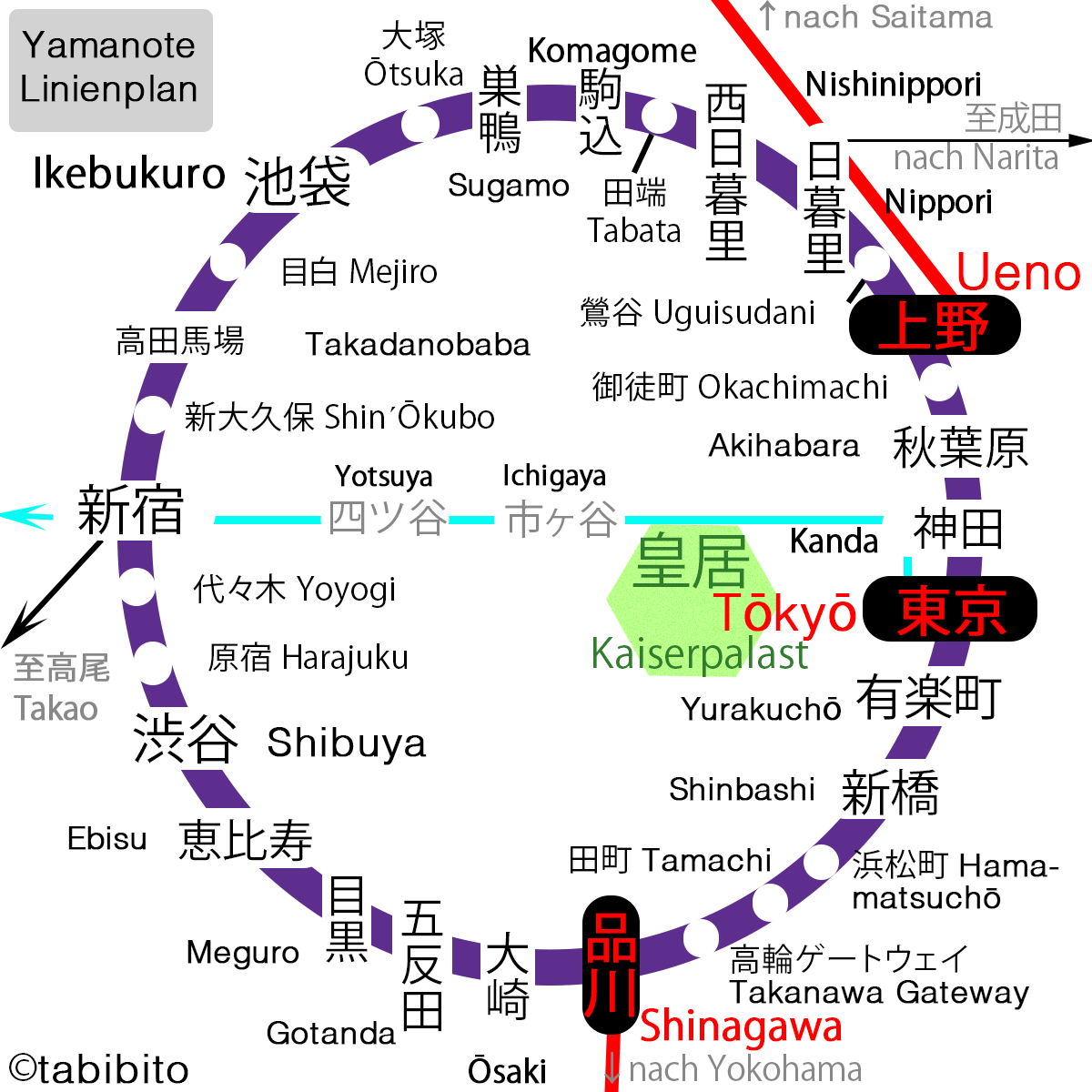
Record-breaking season for these? Not quite – as. once in ten years something happens in the spring. This time, warned the people quite well: A lot of companies, also our, sent their people home in the afternoon. I had to 15 Clock unfortunately an important meeting, and my apologies Compared to several times, that there would be no tea, because all the people are already on the way home. Well – after the meeting, it was probably already too late, and so it went back to the office, Ride out the storm. Since I've now been through several typhoons here, I know about, when and where trains which fail. And a little thrill after work doing quite well. So it went in the evening just before 8 Clock to Ebisu Station. As expected, did not drive my line, So it went with the Yamanote loop line to Osaki. The line from there drove – as expected, because almost all the way underground runs (no, no metro!).
Shin-Kiba was called in to change, But of course, did not drive the line, because the line runs from there and always on stilts along the coast. A gentle breeze, and the line represents. Since 14 Clock. So get out of the station and taxi rank. Amazingly, there were waiting only 3 People. The front man, A young Japanese, asks me a matter of course in Japanese, where I am heading. “After Urayasu!” I answer, and he says, beaming “I also! Do we want to share the taxi?”. But like it. 15 Minutes later, we split the bill – 1,300 yen for each. Ultimately, the journey home took it even a little shorter than usual. Is it. Before 9 Clock I was at home. My line was only after 23:30 again to operate on.
Recently, a Japanese visitor, and asked readers understandably, where one can experience as a Japanese visitor in advance of such weather conditions. Now, The JMA (Japan Meteorological Agency) maintains a very comprehensive website on English, and a casual glance it may be very useful for travel planning:
http://www.jma.go.jp / jma / indexe.html
In particular, the following pages are important to:
This year is the year of the great buildings in Tokyo: Firstly, the 東京ゲートブリッジ Tokyo Gate Bridge at the 12. Opened in February, the other was on 29. February the 634 Meters high 東京スカイツリー Tokyo Sky Tree completed (however the opening is only at the 22. More).
Of course, I once again spared no effort, tell something about the Tokyo Gate Bridge here to. Well, actually it was rather a good excuse, once again to take a tour by bike. The bridge is located near the railway station 新木場 Shin-Kiba to the east of Tokyo and opened a new route between East Kanto or. Chiba and Haneda airport or. Kawasaki und Yokohama.
Obviously it is not far from the airport
Somewhere I had read, that the bridge is also accessible to pedestrians. Who knows, then perhaps also by bike? I thought me so optimistically. So it went through three other bridges and around 10 km to the beginning of the monster, where I had to find it first, that although there are two lanes in each direction for cars, but otherwise there is no room for other vehicles. There are half way up but then a tower with stairs and elevator: With which you can then 8 Stories high drive to the bridge – and go from there. Nix Provided by Fahrrad. And since the new bridge is, there was next to me, of course, many other curious.
The current garbage island in the city of Tokyo
For me, the bridge is particularly interesting, because they have the last two major islands of Tokyo leads or new territory. a good insight into selbige: Both islands were or. are actually still closed to people. A proper name has also not yet be, and so the islands temporarily 中央防波堤外側埋立地 Chūō Bōhatei Sotogawa Umetatechi and 中央 防波堤 内侧 埋 立地 Chūō Bōhatei Uchigawa Umetatechicalled (approximately: Territory outside / inside the main breakwater dam). It can be assumed, that the islands receive proper name, they are ready. The 115 or. 76 Acre islands are partly as a garbage dump and partly used as a cargo port - the larger of the two islands will serve as this year as a container port. On both islands, it looks for the most part quite out of waste. And: Both islands were among my research subjects, I researched during my studies on the coastal edge of Sustainable Development in Planning.
Bridge attendant at work
The plan today was actually, to get to the other side (and then run back, since it is not from the other side for pedestrians continues. The process will take a while, because the bridge is at least 2'618 meters long (and the range between the two middle pillars least 440 Meter). But nothing there: The elevator tower on the other hand, was already within reach, as
the bridge waiting to meet me in a yellow windbreaker and all zurückscheuchte: The towers make 17 Clock to, and since it is not on the other side continues, will be returned?.
Interestingly, it was still, one has from up there but a beautiful view over the city. The visibility was not ideal, but only one has a better view in winter. In the summer, probably a view to the bridge, as a rule hardly worth; unless, to get to the bridge immediately after a typhoon.
Panorama von Tokyo - ganz rechts der Tokyo Sky Tree
And finally, even a photo – this time from below. Since the airport is very close, the planes of the nearly 90 Meter-high bridge also fairly close.
It's just one of those days, where it all comes together. Looked through the morning news – and the following message when I catch the eye: Chance for a severe earthquake within the next capital 4 Years is at 70 Percent. Before the severe earthquake last year, it was said in this regard: 70% in the next 30 Years. From these calculations, one may think, was man will, but the fact, that the plate boundaries and dislocations on since the quake 11. March 2011 have lost stability, can not be dismissed out of hand. In recent 10 Months, there were on average 1.5 Magnitude earthquake 3 to 6 in the Capital Region – these are 5 times more than before the severe earthquake. The widely feared Suto chokka 首都 直下 地震 Jishi – Earthquakes directly under the capital is expected for a long time, because even in the capital there are numerous faults – for example, in northwestern Chiba and Hachioji in. When an earthquake is expected with a thickness of 6.7 to 7.2 and a death toll of about. 11’000 People – partly caused by fires, you can expect with certainty in such a densely populated area.
Well. In the evening just before 9 – I was in a meeting – It was also the same again a lesson – the office began a little longer, to wiggle. But this quake was not in Tokyo, but in Fukushima, and it was also “only” a 5.1. There went out to the point, however, gradually: Heavy snowfall, sometimes accompanied by thunder and lightning, began. No, it is not really boring here.
If the 12. February 2012 is opened and hopefully withstand earthquakes: Die 2'933 m lange Tokyo Gate Bridge
In the past week, a report startled many capital city – and numerous German- and English-language bloggers and foreign media: In 世 田 谷 区 Setagaya-ku, a relatively centrally located and relatively upscale district of Tokyo, was an old, dilapidated wooden house a radiation found, than that given by the Iitate. Iitate is considered one of Japan's verstrahltesten Places and is located in the prefecture of Fukushima.
Specifically, individuals were told when measured in Setagaya-ku has a value of 2.7 Microsievert ago (official report here, Japanese). In Iitate misst man momentan (on average) 2 Microsievert. These are annualized 23.6 Millisievert. The International Atomic Energy Agency and numerous other international authorities recommend an annual dose of more than mere mortals 1 Millisievert (seeMillisievert here, English); other agencies and organizations turn to go from 20 Millisievert per year as an absolutely safe level. In Japan, the limit applies 1 mSv, although the value to 20 wanted to increase mSv for parts of the prefecture of Fukushima or. probably has some.
Perhaps may be one or the other have wondered, why me, the above headline was worth no post. Now: The whole thing smelled something fishy. Why? The value seemed a bit too high. Because: For months, not only measures the government. Thank God. More and more individuals and organizations go with Geiger counters through the capital region and are happy to share their readings to the interested and concerned with others. This is good, commendable and very important. And while a novelty – never have the citizens of their government does not trust as much.
If the measured value now the rule in Setagaya, this would become public in any case more of a plurality of corners and. The media picked the outliers like to, especially as a school passes on the said house. The local authorities took the house under the microscope – and found in a narrow secret fold-like cavity with a box of vials. Therein: Radium. That was until the 1950s often used inter alia in Japan: For example, to illuminate the watch hands in the dark can be. Now – the vials appeared to originate from the time. They were removed, and now we measure the same place less than 0.01 Microsievert. This corresponds to other measurements.
“Foul!” then it rang all sorts of corners. “This smells so after cover-up – that stinks but somehow!”. Well. At this point, once the necessary “What if”- Question: “Was, if there really is someone hoarding bottles of radium – and camped there for decades and have been forgotten?” Impossible? Nein. It is simply logical, that such things are now coming to light: Who is before March 2011 already running with a Geiger counter by Tokyo? Reason to panic or immediate effort-honored conspiracy? Nein. No
Or? Other measurement: In the last week in Yokohama in two places at high (or. relatively high) Strontium concentrations found. Is controversial because, that strontium was measured for the first time as far away from Fukushima. And: Strontium is particularly dangerous, since it is absorbed by the body instead of calcium and incorporated into bone tissue, order to later bone- and trigger other cancers. Now, the maximum measured concentration was in Yokohama 195 Becquerel / Kilogram (See original message here), but it was also measured still not widely. The concentration is relatively low, But there is no denying: Strontium is now also available in the Capital Region.
The general understanding is these days so:
The radiation exposure in the air on a (almost) natural or. negligibly increased level
Drinking water in the capital region is safe (below detection limit)
Vegetables, Meat, Fish, etc.: Sections of charged. Unfortunately, it is difficult to isolate – especially meat and dairy products, since you do not know, where what was fed. You should be safe for marine products in number, buys only, what in western Japan (Japanisches More) or was captured abroad (however: Norwegian salmon is due to British nuclear plant also weighed etc.). You should be safe for vegetables on number, eliminates vegetables from Fukushima, Miyagi, Saitama, Ibaraki, Tokyo, Chiba, Shizuoka, Yamagata, Nagano Niigata und, however Chiba, ShizuShizuokaano and Niigata meanwhile temporarily considered lasted without
Anyone who has children and lives in the Capital Region, avoids old leaves, the space between buildings, The area around manhole covers and virtually all points, where rain water collects easily.
On the last point, however, the following must be said: The values are far too low, external radiation to cause damage. It is about the internal radiation exposure ((Body)Within the traced – (or)naihibaku). Parents should be sure why a precaution, that children do not include in any way dirt from these areas – for example, by playing there and then lick their fingers, etc.. In short: Not in the foliage or around ditches, Manhole covers, etc.. can play.
What happens next?
There is still a lot to come to light. The increased concentrations in the greater Tokyo area with fairly high probability of the middle 2012 virtually disappeared (washed out) be – it was also in Bavaria, a year after the Chernobyl. The leaching of radioactive particles will still cause long term problems in the water cycle.
Actually, this blog is not intended, I know how readers unfamiliar with any kind of happy family photos to, but who reads this blog for a long time, weiss, that there are exceptions once in a blue moon.
While Ms., This year the 9. Months pregnant, moved by the shoe shops (my hand, hoping, that our son is born in such a – But I have to mention, I almost had to force my wife to, sometimes alone and for himself to go out and have fun), I decided, along with daughter, to Tokyo Sky Tree to drive – The new TV Tower Tokyo, the total 634 m is to be highly. Now I see the Tokyo Sky Tree, almost every day – and indeed from my balcony. Almost only, precisely because he 10 km away and hazy days as not visible.
So there I was today with his daughter and made it the other dozens of people to: I took a picture album of family's. And in retrospect was the growth of the two – Daughter and Tower – interesting. Daughter: 1,10 m gross, just 4 Years old become. Tower: 539 m gm gross½ years old. How fast time flies but!
Now I have to edit my only daughter, that they may fly with me to Germany in late April. Until yesterday she was still on fire – But then I made the mistake yesterday, she asked “Are there witches in Germany?” with “And, but! Sure” to answer. Then it was off with anticipation of the trip. I could not just lie… my biology teacher did not leave my head…
So, bored enough with family histories.
The Word of the Day: Growth Seicho. Are length. Growth.